Friday, June 22, 2007

No, I Always Talk Like This

The following from an actual IM conversation I had the other day:

(09:06:15 PM) He: Doesn't the axiom of choice irritate you sometimes?
(09:06:25 PM) Me: not usually. It seems quite reasonable to me.
(09:06:38 PM) He: It's really the well ordering principle
(09:06:40 PM) Me: now, the well ordering principle bugs me.
(09:06:42 PM) He: that bugs me

Observe the 2 second deltas between the last three comments.

Wednesday, April 25, 2007

Gig Wednesday Night

Wow. It sure has been more or less a full semester since I put something up here. No content to add, but I thought I'd announce for posterity if not my glorious and varied readership in Boston that Jesse, Heather and I will be playing a half-hour-ish set Wednesday night (tonight, as I post this at 1:30am). The gig is at the All Asia on Mass Ave, fun will be had by all. We're supposed to go on around 7.

The seminal underground counter-folk pop collective Structure Shy were formed in 1971 by brothers Alec and Saul Heller. Saul left soon after to pursue a solo career and was subsequently eaten by bears. Their current line-up also features Jesse Tov, formerly Stax Records' in-house banjo hand, and Sgt. Heather Mumford, a world renowned naval aviator and flight deck guitarist. After 36 years in rehab, this will be their second public performance.

Saturday, January 20, 2007

Critters En Regalia

There is some preliminary evidence that the creature which is fleeing from the cold by somewhat noisily establishing residence in the space between the roof and my ceiling is, at least temporarily, frightened into quiet by the music of Frank Zappa.

Thursday, January 11, 2007

Aleph-One, Shmaleph-One

"Alec, you know this stuff, does the power set of the Integers have the same cardinality as the Reals?"

Now, every time I think I know how to answer this question, some math guy comes along and babbles on about the Continuum Hypothesis, and I get confused about when my cardinals have Hebrew names. I believe it's well accepted that whatever the cardinality of the Reals might be, it is denoted c.

I think this sucks. It looks like a variable or a constant, and lacks something of the dignity I feel an infinite cardinal should have. Worse, though, you can't pronounce c without establishing context first. Consider: when we talk about Ackermann's Function, we don't call it "aye", we call it "Ackermann's Function". When we talk about Graham's Number, we say "Graham's Number" more often than "gee-sixty-four". (When we talk about them together, mathematicians get upset)

So, not being so visual, I ask you, oh Internet, for a new symbol to denote the cardinality of the Continuum. Hmmmm.... a.... Hieroglyphic Yielding the Amount of the Reals... HYAR... Yes! Come up with any symbol you like. People can vote or something. But from now on, however many reals there happen to be, that number shall be called (in a throaty pirate voice) "HYAR!"

Nalgene Hygene

I've learned how to keep my nalgene (distinguishing mark of we from small liberal arts schools) from getting all skunky. According to lifehacker, keep it in the freezer. I was surprised to find out it worked. If it's already smelling foul, I have found that much better than just constantly trying to scrub it out with soap, boiling water almost immediately kills whatever it is in there making the stink. This has been a public service announcement.

Wednesday, January 10, 2007

"Cool Mathematics"

From Foundations of Mathematics from the perspective of Computer Verification by Henk Barengregt:
Computations alone will not do, as there are many undecidable statements that are provably correct. Considering the Mathematical Universe as a fixed entity gives the working mathematician a strong drive, but one forgets that some properties require a lot of energy to find out (sometimes infinitely much, i.e. one cannot do it). Systems using formal intuitionism for computer mathematics, like Coq and Nuprl have found the right middle way. On the other hand, if intuitionism is considered as a philosophy that states that mathematics only exists in the human mind, one would limit oneself to what may be called in a couple of decades 'pre-historic' mathematics. True, the theories that can be fully run through in our mind constitutes romantic mathematics. But the expected results fully checked by computers that have been checked (by computers that have been checked)n by us will be cool mathematics.

...

Astronomy and biology have also had their romantic phase of going out in the fields and studying butterflies, plants and stars. The biologist at first could see everything with the naked eye. Then came the phase of the microscope. At present biologists use EM (electro-microscopy) or computers (the latter e.g. for gene sequencing). Very cool. The early astronomers could study the planets with the naked eye. Galileo started using a telescope and found the moons of Jupiter and mountains on the earth's moon. Nowadays there are sophisticated tools for observations from satellites. Again, very cool. Still, even today both biology and astronomy remain romantic, albeit in a different way. In a similar manner, the coolness of Computer Mathematics will have its own romantics: human cleverness combined with computer power finding new understandable results.

Sunday, January 07, 2007

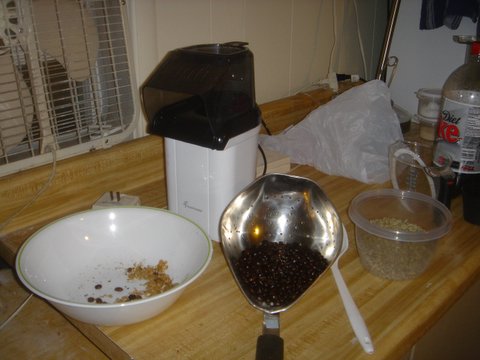
First Roast!

first roast


See, it's funny, because it rhymes with "first post".

On the advice of a coffee expert at work, I have decided to try and roast my on beans at home under the slogan "Massive Quality of Life Improvements for Minimal Expenditure of Effort". Which is not to say that I'm actually expending minimal effort. But it took about 15 minutes start-to-finish to make this batch, and it tastes pretty damn good. My friend Paul tried this in a pan, and it worked, but I went for specialty equipment.

Wednesday, January 03, 2007

Post Holiday Update

I'm back in Boston after a lovely visit to New York. Vacations provide an excellent opportunity to pretend that you have the time to be reading the books that you shouldn't be reading, and this was no exception. I managed to get through Haskell Curry's Outline of a Formalist Philosophy of Mathematics, as well as Philip K. Dick's Ubik, and some reading on the history of science and the science wars. I received a copy of Lucky Jim which I'm about a third through and loving as well.

As a veteran couch surfer, I've found that one way to kill a day while waiting for your host to return home is to go to a library, grab a pile of random books, and just start poking through them. It was in one of these that I found the following about Alonzo Church, which I found interesting enough to share:
He looked like a cross between a panda and a large owl. He spoke slowly in complete paragraphs which seemed to have been read out of a book, evenly and slowly enunciated, as by a talking machine. When interrupted, he would pause for an uncomfortably long period to recover the thread of the argument. He never made casual remarks: they did not belong in the baggage of formal logic.

The full passage can be found here.

Sunday, December 03, 2006

Colbert on Turtles

Stephen Colbert uses Catholicism to explain the "Turtles All the Way Down" philosophy:

Hear me out. I’m a Roman Catholic, the one true faith. And I know Roman Catholicism is the one true faith because Roman Catholicism tells me it is the one true faith, and if you remember from earlier in this sentence, “Roman Catholicism is the one true faith,” so how can it be mistaken?

Thursday, November 30, 2006

A Modest Discipline

It is perhaps worth while saying that semantics as it is conceived in this paper (and in former papers of the author) is a sober and modest discipline which has no pretensions of being a universal patent-medicine for all the ills and diseases of mankind, whether imaginary or real. You will not find in semantics any remedy for decayed teeth or illusions of grandeur or class conflicts. Nor is semantics a device for establishing that everyone except the speaker and his friends is speaking nonsense.

From antiquity to the present day the concepts of semantics have played an important role in the discussions of philosophers, logicians, and philologists. Nevertheless, these concepts have been treated for a long time with a certain amount of suspicion. From a historical standpoint, this suspicion is to be regarded as completely justified. For although the meaning of semantic concepts as they are used in everyday language seems to be rather clear and understandable, still all attempts to characterize this meaning in a general and exact way miscarried. And what is worse, various arguments in which these concepts were involved, and which seemed otherwise quite correct and based upon apparently obvious premises, led frequently to paradoxes and antinomies. It is sufficient to mention here the antinomy of the liar, Richard's antinomy of definability (by means of a finite number of words), and Grelling-Nelson's antinomy of heterological terms.
--Alfred Tarski, The Semantic Conception of Truth and the Foundations of Semantics

Friday, November 17, 2006

A Little "Fashionable Nonsense"

The layers of this "archeology" represent, roughly speaking, a historicized form of the formalist philosophy of mathematics. Where Hilbert relied on the a priori (but ahistorical) "finitary intuition," Foucault formalizes something that romanticism called the historical a priori. In this manner, one gets a discrete sequence of historical configurations, each one being a "meta-theory" for the next. There is no continuity between these archaeological layers; they are presented as incommensurable historical facts, which ultimately makes it seem like Kant is the meta-theoretical condition of possibility of the Spice Girls--the epistemic ground on which they boogie. More seriously, the effects of this approach are nicely described by Sartre...
Vladimir Tasic, from Mathematics and the Roots of Postmodern Thought

Tuesday, November 14, 2006

The Simpsons Teach Category Theory

I had a realization at dinner tonight: Dual Categories are Soviet Russia.

In Soviet Russia, Category is the Dual of you.

Saturday, November 04, 2006

Help Me Lose My Bag

I don't want to carry a backpack around anymore. Ideally, I'd go to work, or out in general, with nothing more than what I could fit in my pockets. Further, I'd not carry some ridiculous amount of stuff in those pockets. I'm looking for novel ideas for how to reduce the amount of gross stuff I carry on my person on a daily basis.

What do I carry now? I carry a cell phone, a pen or two, keys and a wallet in my pockets. In my bag, I carry a book or two, a notebook (paper, I stopped carrying my computer a while ago), and whichever papers I'm currently reading. In addition, I usually carry some Tylenol/Advil. So I'm already traveling pretty light. But I still think I could do without the bag if I could replace the paper notebook and other books somehow.

Currently, I'm inclined to believe that technology is the answer, at least in part. It seems that many people love to get high and mighty about low-tech when answering questions like this ("I've got some technology for you, it's called a 'pen'"). I have no problem with low tech, but low tech won't make my textbook fit in my pocket. Similarly, the reason I carry a notebook is because it holds all my paper/papers together in one unit. So a PDA is probably a good step toward eliminating books and some paper: it can store and display both ebooks and pdfs, as well as a calendar and address book (which I currently do not carry with me; if only I could sync my phone with Google Calendar....). The PDA would even be good for jotting down quick notes.

Where PDAs fail is in any longer form documents, or the real killer, when I need to write down math (which is much more common than any other type of prose I write these days). For that, I don't see how I can avoid pen and paper. However, services and software like scanR are making me think that all I need to do is take pictures of math done on a piece of paper or whiteboard, and then I can have that transformed into clean, digital notes that I can look at later. My phone's camera isn't sufficient for this, but I might consider some other phone or a whole separate digicam for this purpose, if it really worked.

But those are just my ideas; I'd love some help coming up with some novel solutions to not carrying around a bag. Maybe there's a different way to factor the functionality I need? Maybe I should switch to some sort of bandoleer? I'm open to suggestions; how do you keep from lugging around excessive extra storage? What PDA would you recommend for someone who wants to obviate his notebook? Are there any devices out there that are good for writing down math? I look forward to your comments.

Tuesday, October 31, 2006

tRNA message-unit Magic Code?

It is unclear to me whether this is an argument for or against interdisciplinary education.

Sunday, October 29, 2006

Should You Be Attacked by Marauding Visigoths

Hopefully the first in a series of posts on the subject, act two of last week's This American Life (now available as an mp3) has some important advice about defensive weapons systems you might wish to install. It's the bit after the story about Peter Pan.

Sunday, October 22, 2006

Two-Hour Topology Talk

Pardon the alliteration. I spent the second half of last week preparing for my talk on Friday. I gave a two-hour introduction to General Topology. I don't think it went that badly, except for a few moments where I blew a proof (actually, I just left out a quantifier that the proof hinged on. Kelley did the same, but I clearly wasn't quite thinking straight when I copied the proof out to present), and a couple definitions.

Speaking of definitions, it's interesting that one can give an engaging talk for quite a long time only covering basic definitions without providing any real results. This was the second talk I've given for PL Jr; and the second for which I've done precisely that. The last one was on Universal Algebra. I've heard it said before that there are 3 kinds of mathematicians: Algebraists, Topologists, and Analysts. I'll be very surprised if I hit the trifecta.

I think the best line of the day was when someone was trying to claim that the intersection of two open intervals could contain a single point, and hence be closed. I responded by pointing out that no matter how small the intersection was, it was either empty or contained uncountably many points. "And," I contended, "I contend that a set with uncountably many points is not a singleton."

Monday, October 16, 2006

British Syntax

This from A History of Mathematics by Carl B. Boyer. My copy was plundered from John Wiley during their move to Hoboken.

The British contributors to algebra belonging to the generation of Abel and Galois, on the other hand, set out to establish algebra as a "demonstrative science." These men were strongly affected by the fact that England's analytic contributions lagged behind those of the Continent. This was attributed to the superiority of "symbolic reasoning," or, more specifically, of the Leibnizian dy/dx notation over the fluxional dots still prevalent in England.


I find this to be rather funny, but also a bit of an object lesson. Essentially, the British blamed their analytic inferiority on bad notation. It wasn't that they lacked the machinery to do analysis, just that their representation of it was difficult to work with to the point of impeding their progress. To put it another way, they blamed their lack of achievement on bad syntax. It was beaten into me in several math classes in college that good notation leads to insight. I don't see why a programming language's syntax should be thought of any differently.

Friday, October 13, 2006

Observations

It occured to me recently that there are no power sets of cardinality ℵ0.

A question the answer to which did not occur to me recently: does there exists an infinite cardinal n such that there exist more (or less) than 2n functions from n → n?

Thursday, October 12, 2006

Kleene the Platonist?

More from Kleene. I don't know that I've read enough mathematical epistemology, nor do I actually know that much about Kleene, but I find it interesting that he takes this digression in a book about formal systems to plead for meaning.

But in the case of arithmetic and analysis, theories culminating in set theory, mathematicians prior to the current epoch of criticism generally supposed that they were dealing with systems of objects, set up genetically, by definitions purporting to establish their structure completely. The theorems were thought of as expressing truths about these systems, rather than as propositions applying hypothetically to whatever systems of objects (if any) satisfy the axioms. But then how could contradictions have arisen in these subjects, unless there is some defect in the logic, some error in the methods of constructing and reasoning about mathematical objects, which we had hitherto trusted?

To say that now these subjects should instead be established on an axiomatic basis does not of itself dispose of the problem. After axiomatization, there must still be some level at which we have truth and falsity. If the axiomatics is informal, the axioms must be true. If the axiomatics is formal, at least we must believe that the theorems do follow from the axioms; and also there must be some relationship between these results and some actuality outside the axiomatic theory, if the mathematicians' activity is not to reduce to nonsense. The formally axiomatized propositions of mathematics cannot constitute the whole of mathematics; there must also be an intuitively understood mathematics. If we must give up our former belief that it comprises all of arithmetic, analysis and set theory, we shall not be wholly satisfied unless we learn wherein that belief was mistaken, and where now instead to draw a line of separation.

Wednesday, October 11, 2006

This Post is False

Via Kleene's Introduction to Metamathematics, a nice restatement of the Russell Paradox, apparently due to Russell:

A property is called 'predicable' if it applies to itself, 'impredicable' if it does not apply to itself. For example, the property 'abstract' is abstract, and hence predicable. the property 'concrete' is also abstract, and hence is impredicable. What about the property 'impredicable'?